
Advertisement
Did you know that students who engage in reciprocal teaching can improve their reading comprehension by up to 30%? This powerful learning strategy was developed by Annemarie Palincsar and Ann L. Brown in the early 1980s. It aims to help students transition from merely decoding words to actively constructing meaning from text.
At the heart of this method are four essential strategies: predicting, questioning, clarifying, and summarizing. These actions create a framework for student-led discussions, fostering deeper engagement with challenging material. Initially, teachers model these strategies, guiding students as they practice and gradually shift the responsibility to them.
This approach transforms the teacher’s role from a direct instructor to a facilitator, empowering students to lead discussions and monitor their understanding. Throughout this article, we will explore how to implement reciprocal teaching effectively in various contexts, from literature to math word problems.
Introduction to Reciprocal Teaching
Engaging in reciprocal teaching can significantly enhance how students comprehend reading material. This cooperative, student-centered approach allows learners to rotate through four key comprehension strategies while reading a shared text. The primary goal is to make thinking visible, strengthen reading comprehension, and build students’ confidence.
Through this method, students internalize processes they can later apply independently across various subjects. This structured discussion routine empowers students to take responsibility for making sense of a text together.
Many students can decode sentences accurately but struggle to identify the main idea or interpret evidence. Reciprocal teaching addresses this common classroom issue effectively. It encourages students to engage deeply with texts, allowing them to recognize when meaning breaks down.
The purpose behind implementing this strategy is to provide immediate, practical ways for educators to enhance students’ reading skills. It is not merely a theoretical concept but a dynamic approach that fosters active reading habits through repeated prediction, questioning, clarification, and summarization.
This strategy supports students across various ability levels. Teachers can adjust text length, vocabulary support, discussion stems, and role complexity based on individual needs. Importantly, reciprocal teaching is versatile and not limited to reading classes alone.
It can also assist students in understanding historical sources, scientific explanations, policy documents, and multi-step mathematical problems. This flexibility makes it an invaluable tool in any educator’s toolkit.
The Four Core Strategies of Reciprocal Teaching
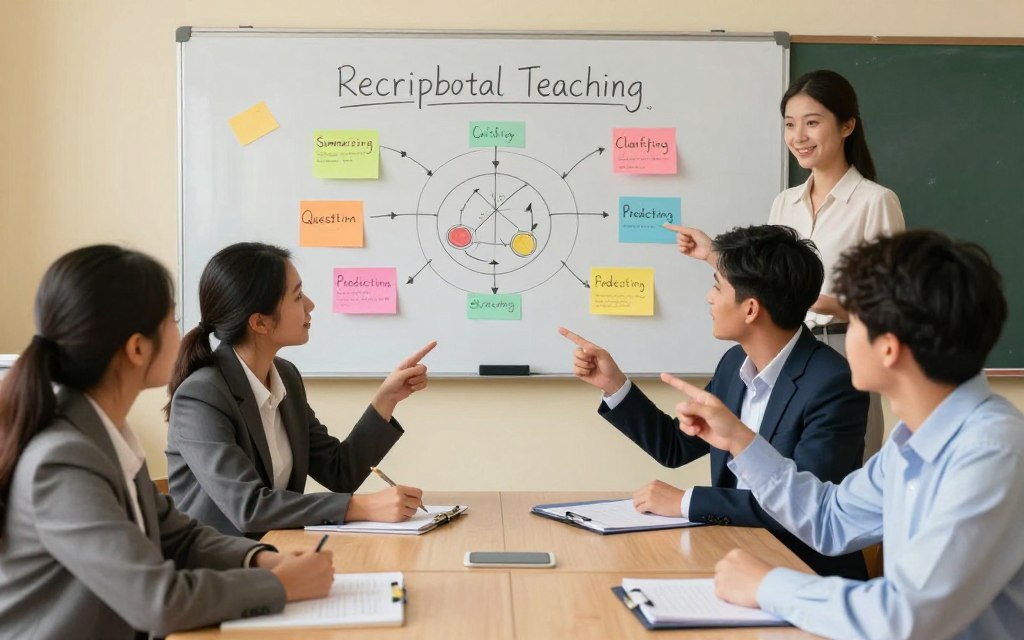
At the heart of effective reading lies the four essential strategies of reciprocal teaching. These strategies help students engage with texts in a meaningful way. They also foster critical thinking and comprehension skills.
Predicting: Activating Prior Knowledge
Predicting is a powerful way to activate prior knowledge. Before reading, students can preview titles, headings, images, and captions. This helps them make predictions about the text.
By connecting visible clues to their expectations, students establish a purpose for reading. This connection enhances their engagement and understanding.
Questioning: Encouraging Critical Inquiry
Asking questions is essential for deep comprehension. Students should learn to progress from simple, literal questions to more complex, inferential ones. For example, they can start with “right there” questions and move towards “think and search” or “author and me” questions.
This progression encourages critical inquiry and helps students evaluate the author’s reasoning and evidence.
Clarifying: Tackling Confusing Texts
Clarifying is a normal part of the reading process. Students often encounter confusing passages. It’s important for them to identify specific barriers instead of just saying a text is difficult.
Effective clarification strategies include rereading, breaking long sentences into parts, and using context clues. Consulting a glossary or recording unfamiliar terms in a shared word bank can also be beneficial.
Summarizing: Synthesizing Key Information
Summarizing allows students to distill central ideas from minor details. They should restate important information in their own words. This practice helps solidify their understanding of the text.
Using a concise claim-evidence-reasoning (CER) structure can guide students in summarizing effectively. They can state what the author argues, cite evidence, and explain its significance.
How Reciprocal Teaching Builds Student Understanding
Students can deepen their understanding of material by working together to explore ideas. This collaborative approach aligns with constructivist learning principles. Here, students co-construct meaning through discussion, evidence, explanation, and revision of their initial interpretations.
Moreover, reciprocal teaching enhances metacognitive development. Students learn to monitor their understanding actively. They identify when comprehension breaks down, choose a fix-up strategy, and evaluate whether their approach worked. This process empowers them to take control of their learning.
Constructivism and Metacognitive Development
In practical classroom terms, students build understanding by connecting new information to prior knowledge. They test their interpretations and revise ideas when the text provides new evidence. This dynamic fosters a rich learning environment where comprehension flourishes.
Fostering Independent Thinking and Academic Ownership
Peer-led dialogue plays a crucial role in making thinking audible. Students explain ideas, listen actively, and challenge interpretations. This interaction fosters academic ownership as they lead parts of the discussion, respond to peers, and become accountable for helping the group understand the text.
The Role of Peer-Led Dialogue in Comprehension
Reciprocal teaching is closely linked to critical thinking. Students must justify their predictions and distinguish strong questions from weak ones. They assess whether evidence supports a claim, which enhances their analytical skills.
Importantly, these skills transfer beyond one lesson. Students learn a repeatable process for approaching unfamiliar content independently. This method equips them with the tools necessary for lifelong learning.
Step-by-Step Implementation of Reciprocal Teaching in the Classroom
Implementing reciprocal teaching can create a vibrant learning environment where students thrive. This structured approach allows educators to effectively guide students through the four core strategies of predicting, questioning, clarifying, and summarizing. By following a clear plan, teachers can enhance student engagement and comprehension.
Structuring Lesson Time and Activities
A well-organized lesson is key to successful reciprocal teaching. Here’s a breakdown of how to structure your lesson time:
| Lesson Duration | Modeling | Guided Practice | Small Group Work | Closure |
|---|---|---|---|---|
| 15-20 minutes | 2 minutes | 5-6 minutes | 7-8 minutes | 2-3 minutes |
| 35-40 minutes | 3-4 minutes | 10-12 minutes | 18-20 minutes | 4-6 minutes |
| 55 minutes | 5-7 minutes | 12-15 minutes | 25-28 minutes (2 cycles) | 5 minutes |
Assigning and Rotating Roles Among Students
Assigning roles helps students take ownership of their learning. Suggested roles include:
- Predictor: Names a clue from the text.
- Questioner: Generates varied questions.
- Clarifier: Applies a fix-up strategy.
- Summarizer: States the key idea.
Rotate these roles by paragraph, page, or section. This ensures that every student practices each comprehension move, fostering a deeper understanding of the text.
Using Modeling and Guided Practice
Modeling is essential in demonstrating the reciprocal teaching cycle. Start with a short teacher think-aloud that shows one complete cycle:
- Preview the text.
- Make a prediction.
- Read a section.
- Clarify a difficult phrase.
- Summarize the meaning.
After modeling, engage students in guided practice. Keep teacher talk brief by prompting students with questions like, “Where do you see that?” or “What could you try next?” This approach encourages them to use context clues and articulate their thoughts.
Close the lesson with a quick product, such as a two-sentence claim-evidence-reasoning (CER), a clarified vocabulary term, or a statement explaining whether the original prediction was confirmed or revised.
Adapting Reciprocal Teaching for Different Grade Levels
Adapting instructional strategies to fit various grade levels can significantly enhance student engagement. Each age group has unique needs that require tailored approaches to ensure comprehension and participation. This section explores how to effectively implement reciprocal teaching across early elementary, upper elementary, and middle to high school settings.
Early Elementary: Emphasis on Visual Supports and Oral Summaries
In early elementary classrooms, students benefit from visual aids and oral language. Here, teachers can utilize pictures, titles, and short sentences to make texts more accessible. Oral summaries allow children to express their understanding before they are required to write responses.
- Shorten reading sections to keep students engaged.
- Use illustrations to support comprehension.
- Encourage students to explain what they learned orally.
Upper Elementary: Gradual Independence and Text Complexity
As students progress to upper elementary, the focus shifts to increasing text length and vocabulary demands. Teachers should maintain predictable discussion steps while introducing more complex materials. Students can preview headings, bold words, and images to aid their understanding.
- Encourage the use of context clues and dictionaries.
- Summarize sections in their own words to promote ownership of learning.
- Gradually increase independence in discussions.
Middle and High School: Complex Texts and Advanced Discourse
In middle and high school, students tackle denser informational texts and primary sources. Here, teachers should challenge learners to examine an author’s purpose, perspective, and evidence. Discussions can delve into bias and source credibility.
- Use complex texts that require critical analysis.
- Discuss perspectives and assumptions related to the material.
- Adjust the length of each role cycle to match students’ attention spans.
Regardless of grade level, teacher modeling is essential when introducing the process. Initially, teachers should demonstrate each role in the reciprocal teaching cycle. As students become more familiar, support can fade from complete think-alouds to brief prompts and checklists.
Role rotation remains valuable at every grade level. This prevents one student from becoming the permanent leader and ensures all learners gain practice in different roles.
| Grade Level | Focus Areas | Teaching Strategies |
|---|---|---|
| Early Elementary | Visual Supports | Short reading sections, oral summaries |
| Upper Elementary | Text Complexity | Context clues, summarization |
| Middle/High School | Critical Analysis | Complex texts, author’s perspective |
Differentiation and Inclusivity in Reciprocal Teaching
Creating an inclusive classroom through differentiation in reciprocal teaching enhances the learning experience for all students. By tailoring strategies to meet diverse needs, educators can ensure that every learner has the opportunity to thrive.
Supporting students with disabilities is vital. These students may benefit from various accommodations. For instance, options like read-alouds, extended time, and frequent monitored breaks can significantly enhance their engagement and understanding. Guided notes and speech-to-text tools can also support their learning process.
Supporting Students with Disabilities
In special education settings, it’s essential to preserve the intellectual value of the original text. This can be achieved by removing unnecessary access barriers. Techniques such as chunking the text, providing brief context notes, and using targeted word banks can be effective.
Additionally, audio summaries and strategic ellipses can help students with disabilities grasp complex ideas. Frequent teacher check-ins during each role can further support their learning journey.
Strategies for Multilingual Learners and ELLs
Multilingual learners can fully participate in reciprocal teaching with the right strategies. Pre-teaching three to five important terms helps build their vocabulary. Allowing the use of bilingual glossaries can also aid comprehension.
Pairing visual information with academic language enhances understanding. Providing sentence stems gives these learners a framework to express their thoughts more clearly.
Meeting the Needs of Advanced Readers
Advanced readers can also benefit from differentiation. They can engage in deeper analysis by evaluating perspective and bias in texts. Encouraging them to compare sources can further enhance their critical thinking skills.
Additionally, creating corroboration questions that require evidence across texts challenges these learners to think critically and independently. This not only enriches their understanding but also fosters a collaborative learning environment.
| Support Strategies | Target Group | Examples |
|---|---|---|
| Read-Alouds | Students with Disabilities | Facilitates comprehension |
| Bilingual Glossaries | Multilingual Learners | Supports vocabulary acquisition |
| Source Comparison | Advanced Readers | Enhances critical analysis |
Tips and Best Practices for Effective Reciprocal Teaching
To maximize the benefits of collaborative learning, it’s crucial to implement effective practices in reciprocal teaching. This method thrives on student engagement and leadership, allowing learners to take ownership of their educational journey. Here are some essential tips to ensure success.
Maintaining Student Engagement and Leadership
Establish predictable routines so students know when to read, pause, speak, listen, record evidence, and move to the next role. This clarity fosters confidence and keeps students engaged.
Protect student leadership by prompting rather than solving issues. Encourage a “three before me” expectation, which urges students to consult peers and resources before asking the teacher for help. This approach promotes independence and accountability.
Using Sentence Stems and Graphic Organizers
Using sentence stems can significantly reduce language barriers without scripting students’ thinking. Effective stems include:
- I predict ___ because ___.
- The confusing part is ___.
- In paragraph ___, ___ refers to ___.
- The author argues ___; the evidence shows ___; therefore ___.
Gradually fade these stems as discussions become more fluent. Additionally, provide graphic organizers that separate predictions, questions, confusing terms, evidence, summaries, and connections. This visual aid helps students see how the strategies work together.
Assessment and Feedback Techniques
Quick assessments can help gauge understanding. Use tools like:
- A two-sentence claim-evidence-reasoning (CER).
- A prediction check.
- A starred evaluative question.
- A 0-2 checklist for claim, evidence, reasoning, and effective clarification.
Give immediate, specific feedback to reinforce learning. Quick exit tasks can also identify whether students understood the text and used the process effectively.
In summary, implementing these tips and best practices will create a dynamic learning environment. Students will thrive in their small groups, take turns leading discussions, and deepen their understanding of the material.
| Materials | Purpose |
|---|---|
| Shared, chunked text | Facilitates group reading |
| Role cards with sentence stems | Guides student responses |
| Fix-up chart | Helps clarify confusion |
| Visible word bank | Supports vocabulary use |
| Timer | Keeps discussions on track |
| Quick observation checklist | Monitors group dynamics |
Evidence-Based Benefits of Reciprocal Teaching
Research shows that structured dialogue in classrooms can lead to significant gains in reading comprehension. The foundational work of Palincsar and Brown demonstrates that when teachers explicitly model comprehension strategies, students can significantly improve their understanding of texts.
A review of 19 experimental studies by Rosenshine and Meister in 1993 found that reciprocal teaching is most effective when students receive explicit instruction before working independently. Gains were notably stronger on experimenter-developed assessments compared to standardized tests. This highlights the importance of tailored instruction in enhancing student learning.
Reciprocal teaching strategies are applicable across various learner populations. This method supports general education students, those receiving special education services, multilingual learners, and students tackling complex disciplinary material. The flexibility of this approach encourages students to engage with texts meaningfully.
Cooperative learning plays a vital role in fostering participation. When students have defined responsibilities, they are more likely to share evidence and listen to their peers. This collaborative environment enhances not only comprehension but also critical thinking and academic conversation.
Moreover, the routine of reciprocal teaching may improve skills beyond comprehension. It strengthens collaboration, source evaluation, and evidence-based writing. According to John Hattie’s Visible Learning MetaX, reciprocal teaching has an effect size of 0.74, indicating promising evidence of its practical impact in the classroom.
| Research Findings | Details |
|---|---|
| Explicit Instruction | Students benefit when teachers model comprehension strategies before independent work. |
| Study Review | Rosenshine and Meister found stronger gains on experimenter-developed assessments. |
| Applicability | Effective across various learner populations, including ELLs and special education. |
| Cooperative Learning | Defined roles encourage participation and collaboration among students. |
| Critical Thinking | Enhances skills in source evaluation and evidence-based writing. |
| Effect Size | 0.74, indicating significant practical impact according to Hattie. |
Enhancing Critical Thinking and Collaboration Through Reciprocal Teaching
Fostering critical thinking and collaboration is essential for enhancing student learning. By encouraging students to engage in meaningful discussions, educators can help them develop essential skills. This section explores how to enhance academic conversations, build cooperative learning, and cultivate independent learners.
Encouraging Academic Conversations and Questioning
Teaching students to ask one another literal, inferential, and evaluative questions is crucial. Instead of relying solely on the teacher to initiate meaningful exchanges, students should take the lead. This approach not only enhances their understanding but also promotes accountability among peers.
Building Cooperative Learning and Accountability
In cooperative learning environments, each student must contribute. They should provide evidence, explain their points, and respond to peers. This shared responsibility ensures that accountability is distributed rather than resting on a single confident speaker.
Developing Reflective and Independent Learners
To develop reflective habits, students can be prompted to consider which strategies helped them most. Questions such as, “Where did comprehension break down?” or “How did your prediction change?” encourage deeper thinking. Additionally, fading role cards and sentence stems helps students become independent learners. They can apply the underlying process without needing constant teacher direction.
For virtual or hybrid classrooms, adapting the conversation structure is essential. Using breakout rooms, shared role sheets, and collaborative documents allows students to engage effectively. Digital word banks and short exit tickets can further support their learning journey.
Conclusion
Understanding complex texts can be made easier through a structured approach. Reciprocal teaching empowers students to engage with reading material by utilizing four essential strategies: predicting, questioning, clarifying, and summarizing. Each strategy addresses a unique aspect of comprehension, making the process more manageable.
To maximize effectiveness, it’s crucial to integrate these strategies into regular classroom routines. Start with accessible texts, model one complete cycle, and provide sentence stems to guide discussions. Remember, differentiation should enhance access without lowering the intellectual demands of the text.
As you implement these strategies, schedule weekly cycles, use quick checks for understanding, and observe group interactions. Gradually release responsibility to students as they gain confidence and independence in their reading abilities.