

Advertisement
Did you know that a mere $1,000 can grow to over $7,358 in just 40 years if invested wisely? This remarkable growth is primarily due to the power of compound interest. Unlike simple interest, which only earns on the initial amount, compound interest allows your money to earn interest on itself over time.
Understanding how this process works is crucial for anyone looking to boost their savings. It involves four key factors: the principal amount, the interest rate, the length of time the money is invested, and how often interest is compounded. For example, at a 5% rate compounded monthly, that same $1,000 would reach $1,051.16 after just one year.
As you can see, the longer you allow your money to grow, the more significant the benefits become. This article will explore various aspects of compound interest, including formulas, compounding schedules, and comparisons with simple interest. Get ready to discover how your savings can work harder for you!
What Is Compound Interest?
Have you ever considered how your money can grow exponentially over time? Compound interest is a powerful tool that allows your investment to increase not just on the original amount, but also on the interest that accumulates. This means that as your balance grows, the amount of interest you earn also increases.
In contrast, simple interest is calculated only on the principal amount. For example, if you invest $1,000 at a 5% rate, you would earn $50 each year with simple interest. Over ten years, this totals $500. However, with compound interest, your earnings can significantly outpace that figure.
After ten years, your $1,000 investment at a 5% rate compounded annually would grow to approximately $1,628.89. That’s a substantial difference compared to the $1,500 you would have with simple interest!
To visualize this concept, think of a snowball rolling down a hill. As it rolls, it picks up more snow, growing larger and larger. Each time interest is added, it compounds on a larger amount, just like the snowball accumulating more snow. This snowball analogy helps to illustrate how compounding works over time.
The difference in growth may seem small at first, but as time passes, the benefits of compound interest become more pronounced. The longer you allow your money to grow, the more significant the advantages become.
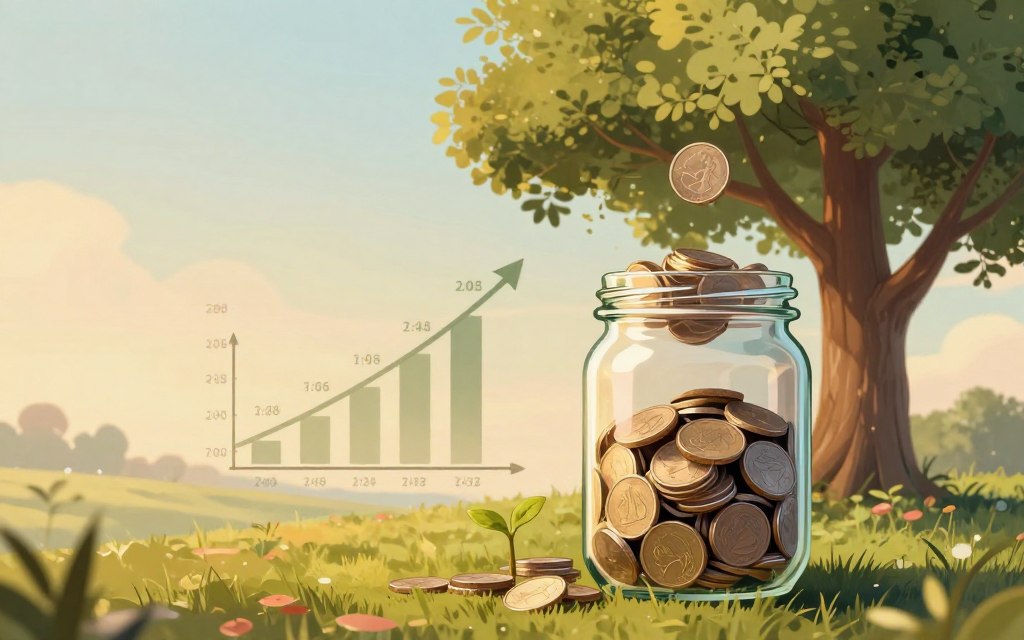
How Compound Interest Works – The Snowball Effect
Imagine if your savings could multiply significantly over time through a powerful financial principle. This principle is known as compound interest. It allows your money to grow not just on the initial amount but also on the interest that accumulates over time.
The formula for calculating compound interest is:
A = P(1 + r/n)^(nt)
In this formula:
- A is the ending balance.
- P is the principal amount (the initial investment).
- r is the annual interest rate (expressed as a decimal).
- n is the number of compounding periods per year.
- t is the number of years the money is invested.
To find the compound interest earned, simply subtract the principal from the ending balance:
Compound Interest = A – P
The Compound Interest Formula Explained
For example, let’s say you invest $2,000 at a 4% rate for three years. If we calculate using daily compounding, the formula becomes:
A = 2000 × (1 + 0.04/365)^(365×3)
This results in an approximate ending balance of $2,254.98.
Example Calculations: Monthly and Daily Compounding
Now, let’s see how monthly compounding affects the outcome. The formula would be:
A = 2000 × (1 + 0.04/12)^(12×3)
This calculation gives an approximate ending balance of $2,254.54. Notice that daily compounding yields a slightly higher balance than monthly compounding.
It’s important to remember that while these formulas provide estimates, real-world results can vary. Factors such as account terms, fees, deposits, withdrawals, and rate changes can all impact your final balance.
The Power of Time and Compounding Frequency
Time plays a crucial role in how your savings can flourish over the years. Each moment your money is invested allows both the original amount and the interest earned to grow. This means that the longer you invest, the more significant your returns can be.
Why Time Is the Most Important Factor
Starting early can matter more than waiting to make a larger one-time contribution. Here’s why:
- Additional years give both your original savings and accumulated interest more opportunities to grow.
- Every year of investment adds to the total balance, compounding your returns.
Compounding Frequency: Daily, Monthly, or Annually?
Compounding frequency also affects growth. More frequent compounding can lead to increased returns, but the difference is often smaller than the impact of leaving money invested for additional years. Here’s a quick comparison:
- Daily compounding generally yields the highest returns.
- Monthly compounding offers a middle ground.
- Annual compounding is the least effective but still beneficial.
Using the Rule of 72 to Estimate Doubling Time
The Rule of 72 is a simple way to estimate how long it may take for your money to double. Just divide 72 by your annual return rate. For example, at a 6% return, your money could double in approximately 12 years. This rule is most useful for rates between 6% and 10%.
Keep in mind that the Rule of 72 is an estimate. It does not account for taxes, fees, changing rates, contributions, withdrawals, or market losses.
Compound Interest in Savings, Investments, and Retirement Accounts
Understanding how compound growth applies to different savings and investment vehicles can change your financial future. Many financial accounts leverage this powerful principle to help your money grow.
Savings Accounts and Certificates of Deposit (CDs)
Savings accounts are a great way to preserve cash while earning interest. They often provide flexible access to your funds, making them ideal for emergency savings. When you choose a savings account with competitive rates and low or no maintenance fees, you maximize your earnings.
On the other hand, certificates of deposit (CDs) are time-based savings products. They typically offer a fixed return in exchange for leaving your deposit untouched until maturity. While CDs can yield higher interest rates, they may impose early-withdrawal penalties. Always review the account insurance, withdrawal rules, fees, and rates before opening an account.
Retirement Accounts: 401(k)s, IRAs, and More
Retirement accounts like 401(k)s, Roth IRAs, and traditional IRAs are designed to support long-term savings. Starting early and contributing consistently can significantly enhance your retirement funds. Even small, regular contributions can accumulate meaningfully over several decades when returns are reinvested.
Many employers offer matching contributions to 401(k) plans, which can further boost your savings. It’s essential to take full advantage of these benefits to maximize your retirement potential.
Reinvested Dividends and Investment Accounts
Reinvested dividends from stocks and mutual funds can also contribute to compounding. When you reinvest dividends, you purchase additional shares, allowing future returns to build on a larger investment base. This strategy can significantly enhance your overall returns over time.
When selecting accounts, compare rates, fees, tax treatment, investment choices, contribution limits, and access rules. Doing so will help you make informed decisions that align with your financial goals.
Avoiding the Dark Side: Compound Interest on Loans and Debt
While compounding can significantly enhance savings, it can also amplify debts if not managed carefully. Understanding how this process works is essential for anyone who has loans or credit cards. When it comes to debt, compounding can quickly turn a manageable balance into a financial burden.
Credit card companies often advertise annual percentage rates (APRs), but the real cost of carrying a balance can be much higher. This is because unpaid balances may accrue interest daily. As interest compounds, it adds to the amount owed, making it even harder to pay off.
How Compound Interest Affects Credit Card Balances
Unpaid credit card balances can grow significantly when daily interest is added repeatedly. For example, if you have a balance of $1,000 with an APR of 20%, your daily interest rate would be about 0.055%. This means that every day, you owe more than the day before.
To illustrate this, consider the following table:
| Day | Balance ($) | Daily Interest ($) |
|---|---|---|
| 1 | 1,000.00 | 0.55 |
| 30 | 1,016.50 | 0.56 |
| 60 | 1,033.23 | 0.57 |
| 90 | 1,050.09 | 0.58 |
As shown, the balance increases over time due to compounding. The longer you carry a balance, the more you pay in interest.
Strategies to Manage and Reduce Compounding Debt
To avoid falling into the trap of compounding debt, consider these strategies:
- Pay the full credit card balance by the due date whenever possible. This helps you avoid interest on purchases.
- Always aim to pay more than the minimum payment. This reduces the principal faster and lessens the amount of interest you owe.
- Prioritize paying off high-interest debt first. This will save you money in the long run.
- Limit new charges on your credit card while you work on reducing your balance.
- Consider balance transfers or refinancing options carefully. Look for low fees and favorable rates.
- If managing debt becomes overwhelming, reach out to a financial professional for guidance.
In conclusion, understanding how compounding works in the context of loans and credit cards is crucial. By implementing smart strategies, you can manage your debt effectively and avoid the pitfalls of compounding.
Conclusion
Consider how a small investment today can lead to significant financial growth in the future. Compound interest allows your savings to earn returns on both the original deposit and the interest already accumulated. The earlier you start saving, the more time your money has to grow.
Remember, factors like interest rates, compounding frequency, and regular contributions play a crucial role in your results. Using savings accounts, CDs, and retirement accounts can help you reach your financial goals.
It’s essential to manage high-interest debt proactively, as compounding can also increase loan balances. Review your current accounts, compare rates, and set up automatic contributions to harness the power of growth for your future.
